Sustainability in Our Organization
Approach to Sustainability Issues and Sustainability Governance Structure
ORIX has diverse businesses, and each business has a wide range of sustainability issues that either affect society or are affected by society. For this reason, we divide our sustainability efforts into two categories: the corporate (Group-wide) level and the business unit level.
Among discussions of sustainability, Group-wide themes are mainly compiled by the Sustainability Department and reported to top management and the Sustainability Committee. At the same time, at Business Unit Strategy Meetings attended by internal directors and heads of business units, including top management, discussions are held as appropriate regarding the promotion of sustainability in each business unit, and these are also reported to the Sustainability Committee on a regular basis. Matters reported to the Sustainability Committee are also reported to the Board of Directors.
| Corporate Level | Business Unit Level | |
|---|---|---|
| Applicability | Group-wide | Specific to each business unit |
| Governance | Sustainability Committee | Sustainability Committee and respective business unit heads |
| Administration | Sustainability Department | Sustainability Department Sustainability contact at respective business unit |
| Key Terms | Unifying culture Minimum standards Zero tolerance Transparency |
Tailored approach and ownership |
Sustainability Governance Structure
The ORIX Group's Board of Directors is responsible for overseeing sustainability-related risks and opportunities across the entire Group.
The Sustainability Committee regularly reports to the Board of Directors. The Board approves sustainability-related policies and oversees progress toward the Group's material issues and key sustainability targets, providing guidance as necessary. In addition, the Audit Committee monitors sustainability-related matters, including climate change, from an internal control and governance perspective. The Committee receives regular reports from the relevant departments and the internal audit function and reviews the status of related initiatives and responses.
On the execution side, the Sustainability Committee deliberates on significant matters related to the execution of sustainability-related activities throughout the Group. Depending on the nature of specific sustainability topics, specialized committees or forums established for particular areas may work in coordination with the Sustainability Committee to review and promote initiatives from a more expert and focused perspective.
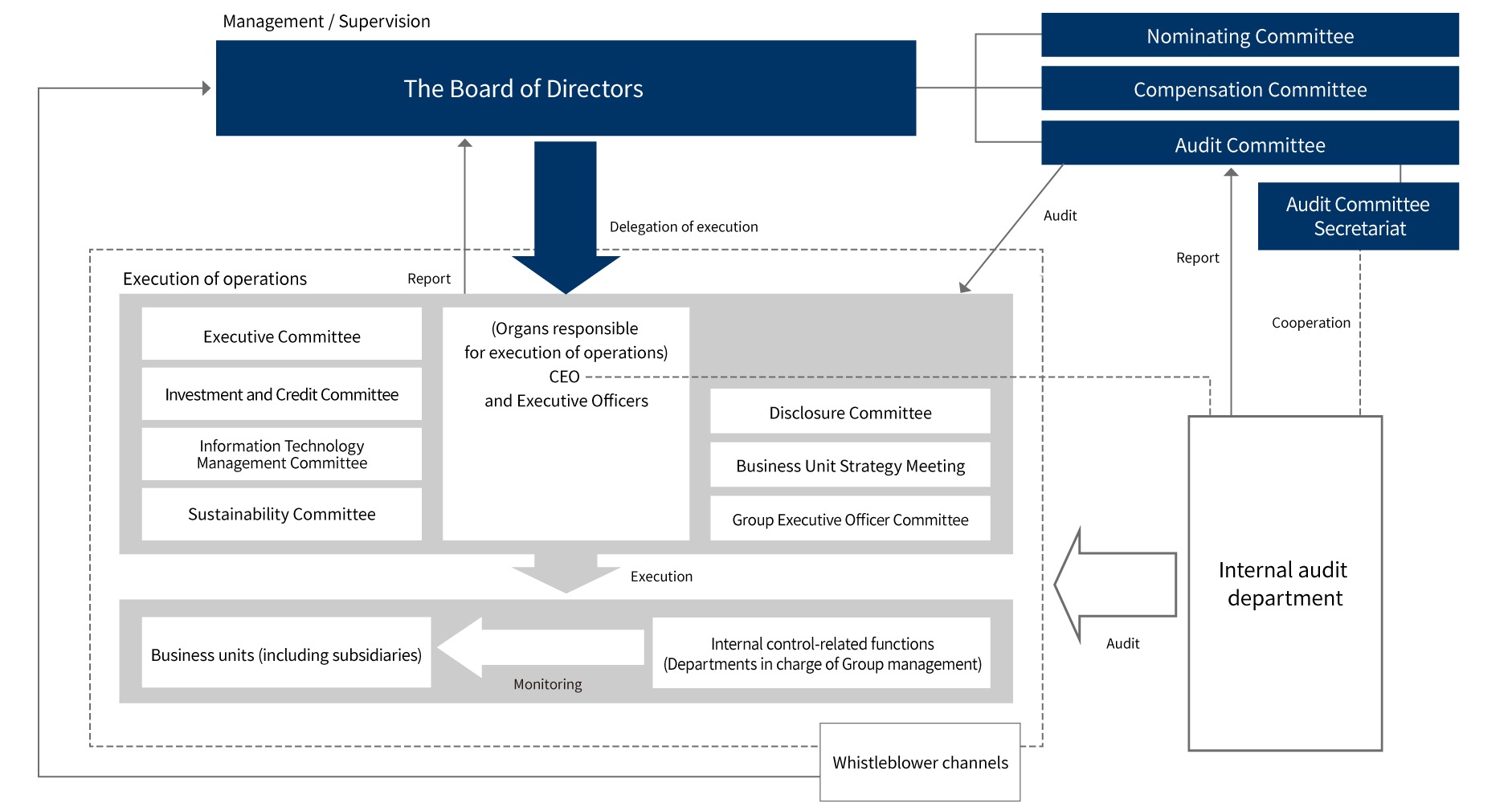
Sustainability Committee
Purpose and position of the Sustainability Committee
The Sustainability Committee discusses and reviews policies, material issues, and key targets for promoting sustainability across the Group, as well as strategies, KPIs, operational procedures, and implementation frameworks for achieving these targets. The Committee reports the outcomes of these discussions to the Board of Directors.
Composition of the Sustainability Committee
Committee members include the CEO, Executive Vice President, COOs of business divisions, CFO, Executive Officer responsible for the Sustainability Department, Executive Officers designated by the CEO, and Group Executive Officers. In addition, an Audit Committee member designated by the Audit Committee, or a person appointed by such Audit Committee member, may attend Sustainability Committee meetings and exercise the authority to conduct investigations of business operations. Other participants may also attend as designated by the CEO, depending on the agenda.
Role of the Sustainability Committee
- Discussion of specific measures to achieve ESG-related key goals
- Discussion of any conflicts arising between short-term earnings and long-term growth
- Discussion of measures to reduce climate change risk following TCFD (Task Force on Climate-related Financial Disclosures) framework
- Sharing of information on corporate sustainability developments both in Japan and overseas
- Discussion of matters to report to the Board of Directors
Sustainability Promotion Status
Group-wide Themes
(1) Performance for the fiscal year ended March 2025
- Strengthening supply chain management system: Initiatives implemented in ORIX Auto, ORIX Rentec, and the Real Estate segment, along with the resulting improvements in third-party evaluations.
- Preparing to comply with disclosure regulations: Accelerating GHG emissions calculation processes incorporating them into disclosure control processes.
(2) Focus themes for the fiscal year ending March 2026
- Updating key goals and material issues: Progress toward 2030 goals remains steady. We will update goals and issues in light of ORIX’s long-term vision and the forthcoming SSBJ standards.
- Reducing Scope 2 emissions: We have formulated reduction plans for each major emission site and will implement reductions in phases.
- Maintaining and improving ESG ratings: Based on peer comparisons, we will continue working to maintain and improve five ESG ratings.
Business Unit Level Approach
(1) Major initiatives for the fiscal year ended March 2025
- Auto: In the leasing business, increased the proportion of next-generation vehicles.*1 Advanced the use of green electricity for our own operations, and formulated a Supplier Code of Conduct
 [239KB] (in Japanese).
 - Rentec: Conducted a second round of supplier questionnaire surveys. Developed CSR Procurement Guidelines[427KB] (in Japanese) and an explanatory handbook, and communicated them to key suppliers.
- Real Estate: Accelerated the renewal of energy-saving equipment at owned properties, expanded the use of renewable electricity. Continued to promote food waste recycling.
- Environment and Energy: Conducted quantitative verification toward the conversion of coal–biomass co-fired power plants to biomass-only operations.
- Banking: Executed sustainable finance.
- Ship Business: Placed newbuilding orders for next-generation fuel vessels.*2
(2) Approach of each business unit from the fiscal year ending March 2026 onward
Please refer to Material Issues for Specific Business Areas.
- Hybrid vehicles (HV), plug-in hybrid vehicles (PHV), electric vehicles (EV), and fuel cell vehicles (FCV).
- Dual-fuel vessels powered by methanol and heavy oil.