
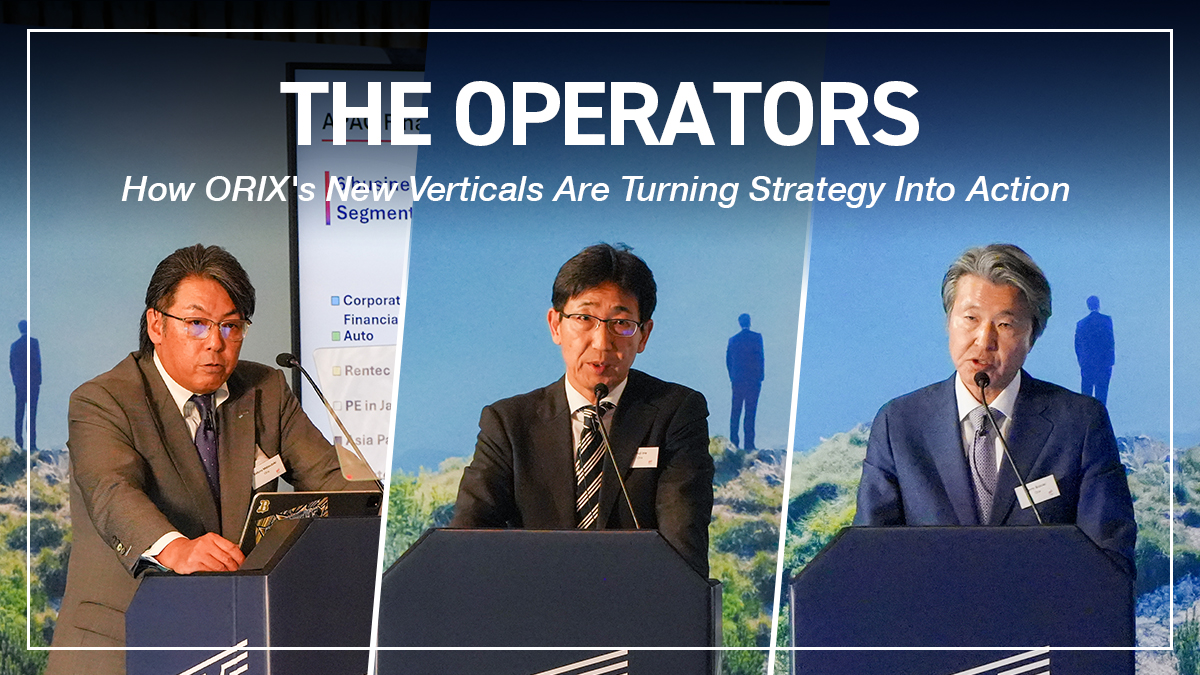
When ORIX launched its Growth Strategy 2035 in May 2025, it set two headline targets - net income of 1 trillion yen and a return on equity of 15% - as well as a central ambition: to transform itself from a balance sheet investor into a global asset management and operations platform. In January 2026, the company created four new business segments to execute on the business transformation needed to make this vision a reality: Japan & APAC, Infrastructure, USA & Europe, and Insurance.
These four segments replaced the 10 segments that ORIX had accumulated over six decades of diversification. As CEO Hidetake Takahashi explains: “ORIX has expanded significantly in both business domains and geographic reach, growing into a global corporate group with diverse expertise and deep on‑the‑ground knowledge. To turn this scale and complexity into a source of strength, we must evolve from a management model centered on a CEO who makes every key decision to one where each member of the leadership team brings their expertise to bear, and decisions are made from a Group‑wide perspective.” The leadership team he refers to includes the newly appointed Chief Operating Officers of three of these segments: Satoru Matsuzaki, COO of Japan & APAC, Shuji Irie, COO of Infrastructure, and Terry Suzuki, COO of USA & Europe.
Each COO bears clear responsibility for capital allocation and financial returns. As Mr. Takahashi puts it, the goal is less about simplifying ORIX Group’s portfolio – its diversity is its strength – and more about clarifying roles and improving communication to reap synergies across the Group.
Japan & APAC: a growth platform for financial services and beyond
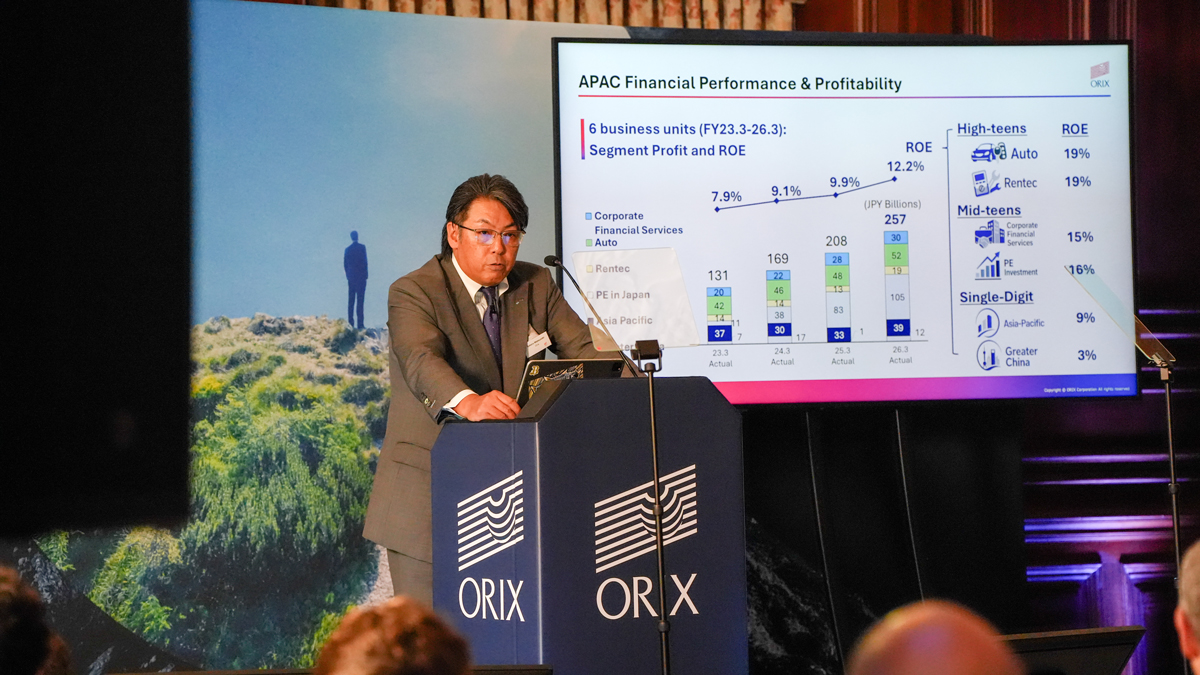
Satoru Matsuzaki's Japan & APAC segment is at first glance a region, but is more broadly the home of ORIX’s financial services businesses. It encompasses corporate financial services and business solutions in Japan, auto leasing and fleet management, Rentec equipment leasing, private equity investments in Japan, and financial services and investments across a dozen APAC markets. Together they represent decades of diversification that Mr. Matsuzaki points out provide significant competitive advantage.
The numbers are striking. The auto business manages 1.42 million vehicles, among the largest fleets in the world. Rentec offers some 40,000 types of ICT and measuring equipment. The private equity unit has made 33 investments with an IRR of approximately 25%. The unit's overall ROE already stands at 12%, with auto and Rentec leading at around 19% each, reflecting the efficiency of what Mr. Matsuzaki describes as fully evolved business process outsourcing models. Corporate financial services and PE both produce mid-teens returns. Some APAC subsidiaries are still in single digits but growing, and Mr. Matsuzaki is unambiguous about their role: "We see the region as a key growth driver as we increase scale."
His strategy rests on two pillars. The first is unlocking synergies that have so far gone unrealized. Each APAC country has historically operated independently. Going forward, Mr. Matsuzaki intends to drive strategic integration across the platform by leveraging group-wide resources that, in his own assessment, have been underutilized until now. The new ORIX Fleet platform is a prime example: linking ORIX entities in 11 APAC countries across one platform to help customers combine regional scale with on-the-ground capability to support multi-market fleet programs more effectively. This type of coordinated approach deepens customer relationships and improves returns as it scales.
The second pillar is exporting Japan's business solutions model to APAC. In Japan, ORIX has built a remarkably wide service offering for corporate clients, from life insurance brokerage to M&A advisory. In some cases, ORIX advises both buyer and seller in a transaction. "Our expertise is to combine solutions and tailor them to client needs," Mr. Matsuzaki explained. "This is not easy for others to replicate."
Central to rolling this model out across APAC is something Mr. Matsuzaki calls ORIX's “frontline-driven DNA”: the belief that new businesses emerge from the free ideas of people on the front line, not from directives handed down from headquarters. In Japan, leasing and loans create regular touchpoints with customers, and ORIX teams have learned to identify management challenges through ongoing dialogue and then to build new services to solve these. In many APAC markets, transactions are still conducted through dealers, making customer contact more indirect.
Deepening that direct customer dialogue and replicating the adjacent-domain expansion mindset that has made ORIX's Japan business so distinctive are among the unit's highest strategic priorities. Mr. Matsuzaki is realistic about timing: he expects it to take three years for the new mindset to take hold across the region, and five years before the results show up in the numbers.
In terms of shifting to an asset management model, he points to the recent partnership with Qatar Investment Authority, a $2.5 billion joint platform targeting Japanese PE opportunities, particularly in SMEs, where ORIX's origination depth is unmatched with a network of over 400,000 clients in Japan. The QIA relationship also illustrates a second way in which the integrated Japan & APAC structure creates value. When a portfolio company seeks to expand overseas, it can now draw on ORIX's local subsidiaries across the region, which have built trust and track records over decades in each market. The QIA relationship is a template for what Mr. Matsuzaki wants to build: ORIX as the leading investor and responsible for sourcing and managing deals, while a growing roster of Limited Partners (LPs) contributes capital and scale.
In short, Japan & APAC will become a growth platform for the Group – and be at the heart of achieving ORIX’s 2035 vision. Key to that are people, Mr. Matsuzaki argues. He is investing in talent mobility: rotating people across businesses and geographies at an earlier career stage than has been the norm at ORIX, so that they develop wider perspectives before they become senior leadership candidates. Cross-functional task forces that cut across organizational boundaries are a complementary tool, allowing insights from one country or business domain to be shared and applied across others. Developing the next generation of leaders and building a sustainable organization is essential. "I have told our staff that working as usual will not deliver the next phase of growth," he says. "We must continue to take ownership of new challenges, identify opportunities ourselves, and act proactively."
Infrastructure: scaling ORIX's global assets
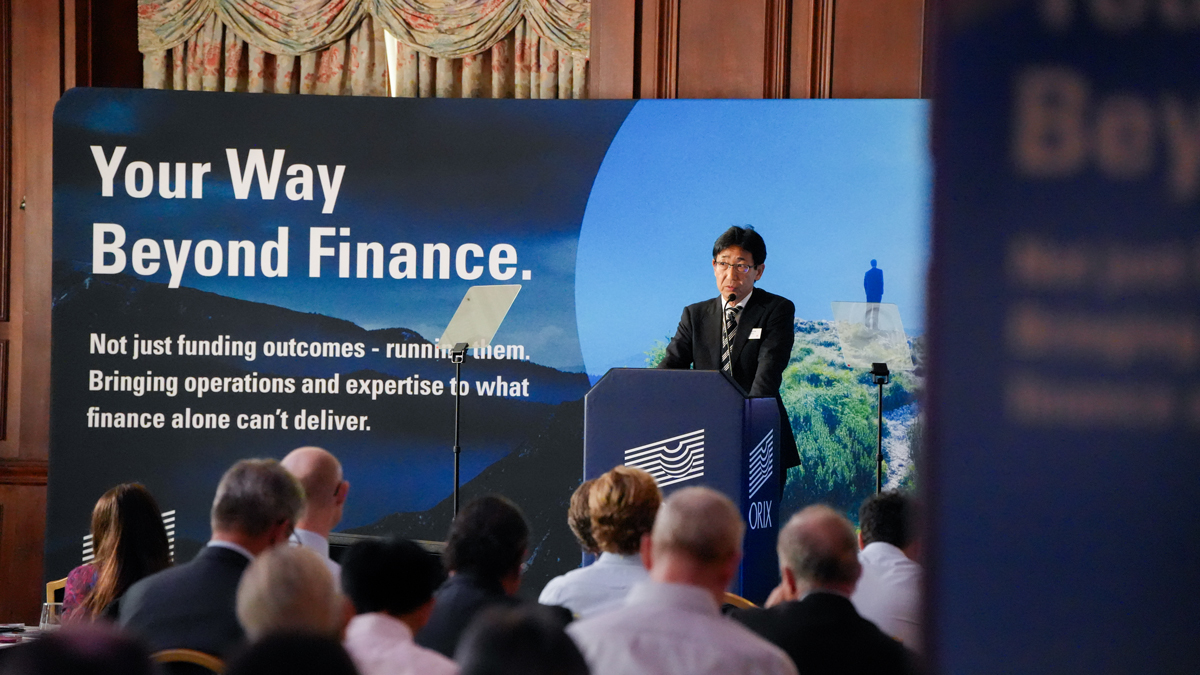
ORIX's Infrastructure segment covers five areas: renewable energy, where ORIX is Japan's leading private player; aviation, where it holds a leading position in aircraft leasing, trading and asset management; shipping, where it is the only firm in Japan operating ownership, fleet management, brokerage and finance at scale simultaneously; real estate, spanning office, residential, logistics, hospitality and mixed-use properties; and public infrastructure, including the Kansai three-airport concession group and Japan's first Integrated Resort in Osaka.
What these five have in common, COO Shuji Irie argues, is strong long-term demand, tangible assets and the capacity for value creation through active management - precisely the characteristics that suit ORIX's ambition of becoming a leading alternative asset manager.
The segment already manages 3.6 trillion yen in assets, produces a 13.9% ROE and is supported by 1.5 trillion yen of equity capital - one third of the Group's entire capital base. "The foundation is in place," Mr. Irie says. "My mission is to further leverage the capabilities we already have and convert them into sustainable growth."
Mr. Irie identifies four sources of competitive advantage: ORIX's track record and scale; decades of asset management experience; balance sheet strength that enables investment, development and efficient asset rotation; and, in Japan especially, a trusted brand with hundreds of thousands of customers. "These strengths allow ORIX to create value beyond ownership," he argues. Underlying all of this, he says, is a cultural disposition that he regards as ORIX's deepest competitive asset: the drive to step forward when others hesitate. "The greatest obstacle to growth is not failure itself, but opportunity loss," he says. "When we pass on a project, no loss appears on the surface - yet the experience we forgo, and the future growth opportunities we miss, are far from insignificant."
The industry strategies follow that logic. In energy, the team is moving beyond straight solar farm ownership, into battery storage, digital aggregation, energy trading, green ammonia and data centers - areas where rising electricity demand and national energy security concerns are creating structural opportunities even as near-term market conditions remain challenging. In transportation, the aviation platform is expanding from aircraft bodies into engines and parts. In shipping, a new joint venture is extending the platform. In each case, the goal is the same: build an ecosystem that attracts third-party investors and funds, not simply a portfolio of owned assets.
In real estate, Mr. Irie is calling for discipline: metropolitan and large-city assets, selective on property type, focused on locations with strong demand and liquidity, and flexible on the vehicle — J-REIT, separate managed account, or balance sheet — depending on what each asset warrants. The first infrastructure value-add fund, ORIVA I, has already been launched. He notes that rising construction costs - widely seen as a headwind - are in fact constraining new supply and creating significant opportunities to enhance the value of existing assets through repositioning and renovation.
On asset management more broadly, Mr. Irie is careful to frame the goal in terms that go beyond fee income. The shift to asset management is, in his view, a way to capture a greater number of investment opportunities and accelerate business growth. By attracting external capital to projects that ORIX originates, and by enhancing asset value through operations, the firm can pursue a larger deal set than its own balance sheet alone would allow.
He also frames the relationship with investors explicitly as long-term: "We do not view investors merely as providers of capital, but as partners with whom we seek mutual growth and shared prosperity." And in a new expression of the Kansai spirit that has driven ORIX since its inception, the group is developing Japan’s first Integrated Resort – comprising a casino, hotels, a conference center and more – with US partner MGM Resorts International. This project is one of Japan’s largest future tourism and entertainment developments and its location on an artificial island in Osaka Bay will draw tourists into the whole Kansai region - benefiting ORIX’s airport concessions, metropolitan hotels and leisure facilities.
For ORIX, this is more than a single project, says Mr. Irie. It represents an opportunity to create value across the portfolio. "Our goal is clear," he concludes. "To become the number one alternative asset player in the world and to meaningfully contribute to ORIX's targets of generating 1 trillion yen of net profit and 15% ROE."
USA & Europe: two continents, one asset management business
Terry Suzuki's USA & Europe segment also seems to be a regional play at first take, and while the main businesses it covers are primarily in these two regions, the grouping really comprises the company’s asset management businesses. ORIX USA started more than 45 years ago in leasing, moved progressively into corporate and real estate finance, then capital markets, then alternative assets. Today, it manages $32 billion of third-party capital across three alternative asset classes: corporate private credit; asset-based private credit; and real estate equity and debt.
The shift in business model since 2019 has been deliberate. "Historically, ORIX USA invested its own balance sheet directly," Mr. Suzuki explains. "This worked but capped returns." Adding third-party funds has changed the economics: ORIX now earns management and incentive fees alongside its own returns, can compete for larger deals, and makes every dollar of its own capital work harder alongside co-investor capital. As the fee income base grows with AUM, the ROE improves and the quality of earnings rises.
However, one principle remains rock solid: "We do not recommend investments to investors that we have not made ourselves," he says. This co-investment discipline is, in his view, a key differentiator in attracting third-party capital and building the long-term relationships of trust that the business requires. Mr. Suzuki is explicit that this hybrid model — own balance sheet combined with third-party capital — is central to achieving the Group's 15% ROE target.
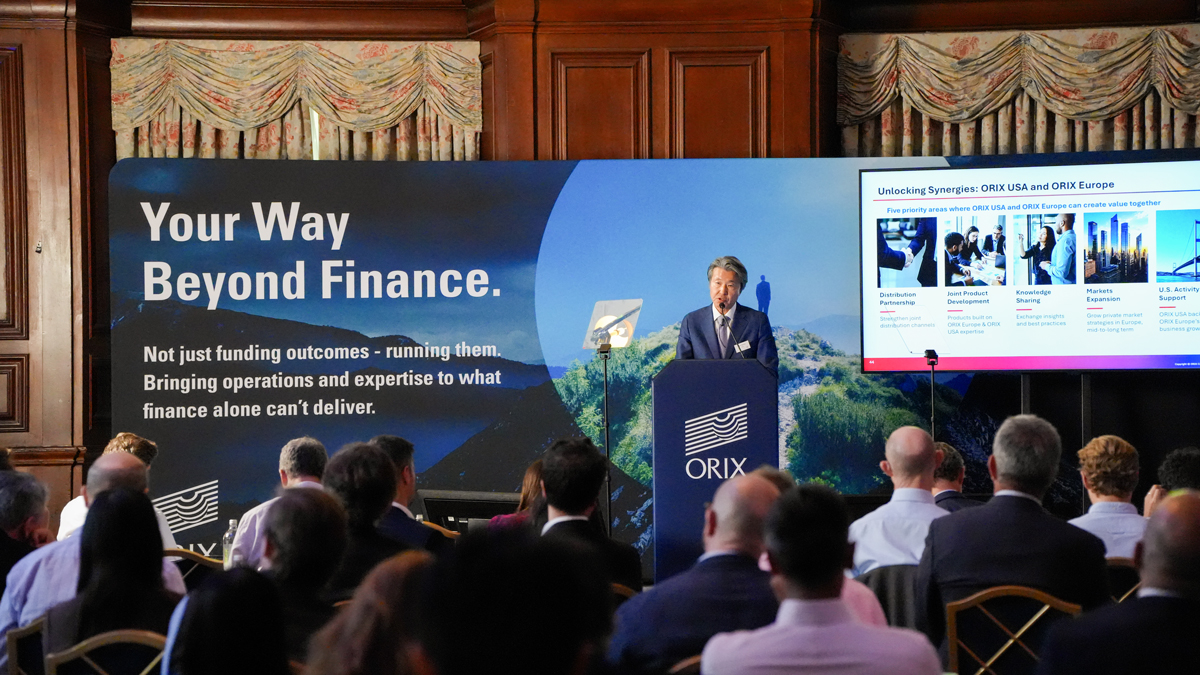
The more consequential strategic move, however, is the alignment of ORIX USA and ORIX Europe into one vertical. Together, the two manage over $500 billion in combined assets - the vast majority of that through Robeco in Europe, invested primarily in public equity and fixed income, with ORIX USA's investments concentrated in private markets. The franchises serve over 1,000 institutional clients with very little overlap. "By bringing them together, we can offer all of our clients both private market expertise and public market capabilities across two distribution networks in the US and Europe," says Mr. Suzuki. "Together, we will be among the 30 largest global asset managers - and one global asset manager, not two regional players."
The integration has five priorities: mutual distribution, joint product development, knowledge sharing, extending US private strategies and the Hilco platform across Europe, and helping Robeco build its presence in America. On joint product development, he points to the needs of institutional investors such as life insurance companies, which construct portfolios that combine equities and fixed income with private credit and real estate. For these clients, ORIX can now offer integrated solutions that draw on expertise in both traditional and alternative asset classes - something few asset managers can credibly claim.
Mr. Suzuki reports that his team is already seeing early synergies both in designing new products and in distributing them more widely. Within private credit specifically, he sees asset-based lending (ABL) as a high-growth area. Unlike lending based solely on corporate creditworthiness, ABL focuses on the value of the underlying collateral - and Hilco Global, acquired in 2025, brings nearly 40 years of specialist asset valuation expertise that provides a durable competitive advantage. ORIX intends to leverage its global network to extend Hilco Global's valuation capabilities and ABL business into Europe and eventually across APAC, including Japan.
The direction is clear: ORIX’s US and European asset management franchises are moving from two parallel operations toward a single, integrated business unit that shares resources and best practices while preserving the local autonomy good execution requires.
More than the sum of their parts
The key takeaway is that the new management architecture is now genuinely functional - and that its most powerful feature is not just the clarity it brings to individual verticals, but the connections it creates between them. Each vertical strengthens the others.
This is what Growth Strategy 2035 ultimately requires - and is starting to deliver: not three businesses running in parallel, but three businesses that actively reinforce one another. A CEO with a clear vision, a CFO & CSO executing the transformation, and three COOs running operationally distinct but strategically aligned verticals. The architecture is in place, the ambitions are shared, and the work of building something genuinely greater than the sum of its parts is underway.

