Infrastructure Business COO Message
Leveraging Our Drive to Take on Challenges to Advance the Infrastructure Business
to the Next Stage of Growth
Shuji Irie
Member of the Board of Directors
Senior Managing Executive Officer
Chief Operating Officer, Infrastructure Business Unit
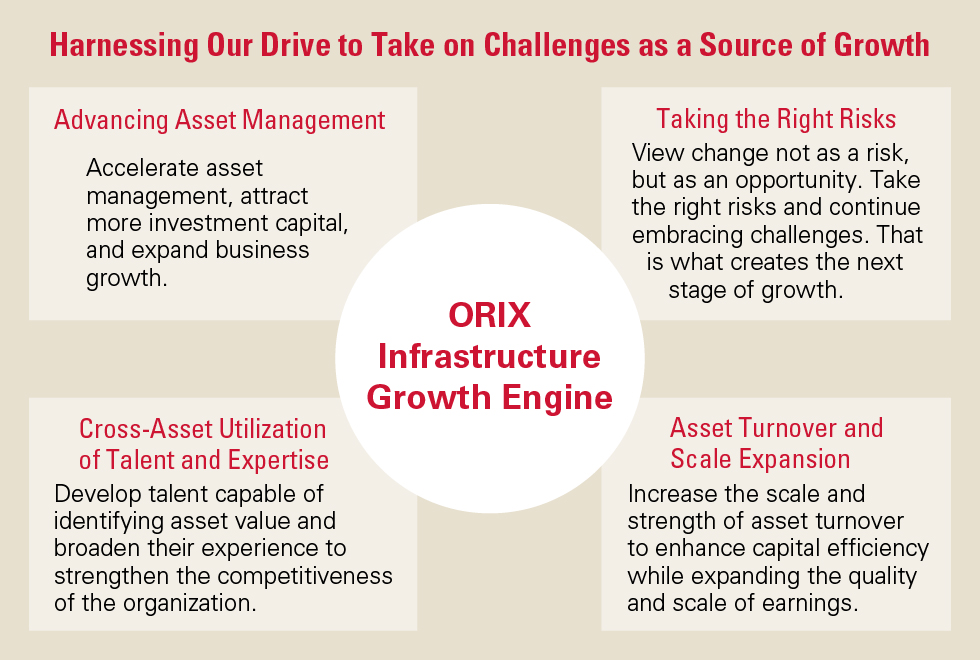
Harnessing Our Drive to Take on Challenges as a Source of Growth
Since becoming COO of the Infrastructure Business Unit, I have felt strongly that ORIX must further unleash its natural drive to take on new challenges.
Throughout its history, ORIX has advanced by boldly entering fields untouched by other companies and by pursuing opportunities in new markets, using each experience as a springboard for the next stage of growth. The Osaka Integrated Resort (IR) project and our concession agreements for the three airports in the Kansai region are natural extensions of that approach. Stepping forward when others hesitate—and opening markets through our own initiative—is, in my view, part of ORIX’s DNA.
I believe that the greatest obstacle to growth is not failure itself, but opportunity loss. When we pass on a project, no loss appears on the surface. Yet the experience we forgo, and the future growth opportunities we miss by not taking on the challenge, are far from insignificant. The key is to assess risks appropriately, take the right risks, and continue to challenge ourselves. Sustaining these efforts over time creates new business opportunities and fuels the next phase of growth. This mindset is reflected in ORIX’s business model. Our strength lies in our ability to leverage our own balance sheet to generate new investment opportunities. In new markets and business domains, we have taken risks, nurtured businesses, and built deep insights and expertise along the way. I believe this stance—first taking on challenges ourselves—is the very source of what makes ORIX unique.
The Infrastructure Business Unit encompasses businesses that manage a diverse range of real assets, including Environment and Energy, Aircraft and Ships, Real Estate, Public Infrastructure, and the Osaka IR project. Each business is distinct, yet they share a common core: identifying investment opportunities, enhancing value, and improving profitability through operations. Likewise, all are real, physical assets supported by long-term demand, and are capable of generating stable cash flows.
The purpose of establishing the Infrastructure Business Unit is not simply to group these businesses together. It is to bring together the knowledge, talent, and investment expertise cultivated in each business and create new value across the entire infrastructure portfolio. By drawing on the expertise and talent developed across our businesses, we will operate the infrastructure segment as a unified platform and drive sustainable growth.
Making Asset Management a Driver of Growth
In considering the future growth of the Infrastructure Business Unit, one concept I view as particularly important is the shift toward asset management. The goal is not simply to increase fee income. What we aim to build is a framework that allows us to capture a greater number of investment opportunities and accelerate business growth.
Up to now, ORIX has leveraged its own balance sheet, taken on risk, and enhanced the value of assets and businesses—building a diverse business foundation and deep expertise in the process. At the same time, investment opportunities surrounding infrastructure assets will continue to expand. If we rely solely on ORIX’s balance sheet, there will inevitably be limits to the opportunities we can pursue. That is why it is essential to establish a framework that expands growth opportunities by drawing on investor capital as well. By attracting external capital to the projects ORIX originates, and by enhancing asset value through operations and value‑creation initiatives, we can unlock larger investment opportunities and accelerate business expansion. I see asset management as a critical means of achieving this.
As our asset management business grows, so does our experience. A larger pool of assets sharpens our capabilities in value enhancement. Broader engagement with investors brings in new information and new opportunities. This experience directly contributes to the growth of our people and our organization.
Advancing asset management also requires building long‑term relationships with investors. We do not view investors merely as providers of capital, but as partners with whom we seek mutual growth and shared prosperity. Rather than monopolizing returns or shifting risk onto others, we aim to deliver value aligned with each investor’s risk tolerance and expected returns, and to build long‑term relationships founded on trust.
Finding Investment Opportunities and Creating New Value Amid Change
To achieve our 2035 targets of ¥1 trillion in net income and 15% ROE, it will be essential to capture more new investment opportunities than ever before and expand both the scale and profitability of our businesses.
The environment surrounding infrastructure businesses is undergoing significant change. Inflation, rising interest rates, and higher construction costs are widely viewed as headwinds for many sectors. Yet what matters most is not to see these changes solely as risks, but also to recognize them as sources of new investment opportunities.
In the real estate market, for example, rising construction costs are constraining new supply, creating great opportunities to enhance the value of existing assets. Opportunities to increase asset value through repositioning or renovation are also growing. Rather than holding back on investment simply because interest rates have risen, I believe it is important to focus on how we can create value within this environment.
Medium‑ to long‑term shifts in social structure are also generating new investment opportunities. The growth of energy transition initiatives and rising demand for electricity driven by the spread of AI are prime examples. Adjacent fields such as battery storage and data centers—areas where we can leverage our strengths—offer significant potential.
We have no intention of expanding indiscriminately into completely unfamiliar areas. Our basic approach is to expand into adjacent areas where we can leverage our existing strengths. If a market shows growth potential and is a domain where we can create value, we will actively take on the challenge. Building on these efforts over time will lead to new growth opportunities. The Osaka IR project is one such example of this approach. By bringing together the knowledge and experience we have gained across our businesses—including investment in real assets, business operations, and collaboration with partners—we are taking on the challenge of creating new long‑term value.
Cross-Asset Talent as a Competitive Advantage
Our people are, in my view, the most important asset in driving the integrated management of the Infrastructure Business Unit.
To continue identifying new opportunities amid change, it is essential to develop talent who can operate across different domains. Going forward, it will be increasingly important for our people not only to deepen their expertise in their own fields, but also to understand multiple asset classes and think across them. While each asset class has its own characteristics, the underlying framework—investment decision-making, value enhancement, operations, and delivery of value to investors—is largely the same. When people gain experience across multiple asset classes, they begin to see how the insights they have developed in one area can be applied to others. In projects like the three airports in the Kansai region—where aviation, real estate, public‑infrastructure operations, and collaboration with overseas companies all intersect—this breadth of experience becomes a powerful advantage.
I believe that people grow through real experience. More opportunities to take on challenges lead to greater experience. Greater experience leads to deeper insight. That insight generates the next investment opportunity and drives further growth. Creating this positive cycle is, above all, what strengthens the competitiveness of our organization.
In my own career, I have gained a wide range of experience by working across many businesses and projects. Passing that knowledge on to the next generation—and seeing young talent grow into individuals who can work across domains—is one of my greatest sources of satisfaction.
The Infrastructure Business Unit offers an environment where people can broaden their perspective by gaining experience with diverse asset classes. As the talent developed here collaborates across business boundaries and creates new value, we can build on those efforts to evolve the entire infrastructure business into a unified platform for growth.